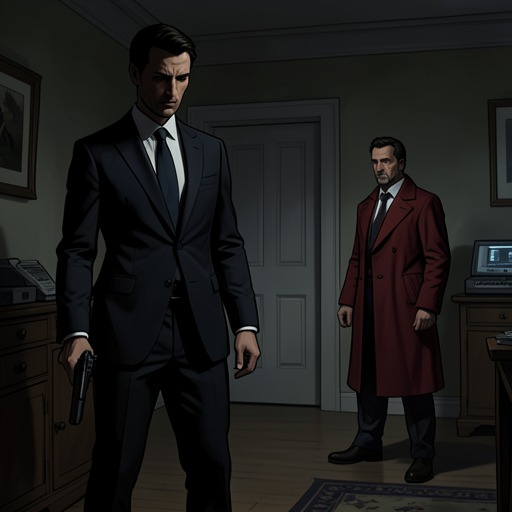
Le Chiffre's torture of Bond
Casino RoyaleLe Chiffre’s torture of James Bond is an effort to recover the money Bond won at baccarat by breaking his resistance and extracting information. The interrogation turns the public contest of the casino into a private struggle over money, endurance, and control: Bond is restrained and repeatedly asked where the money is, while Le Chiffre tries to make him believe that escape and rescue are impossible. The scene is interrupted at the moment Le Chiffre threatens to question Vesper as well.
Causes and Stakes
The confrontation follows Bond’s conspicuous success at the baccarat table. He had collected twenty-four million francs and later followed a thirty-two-million-franc stake, a sum the spectators recognized as a small fortune. The casino’s measured rituals of betting and dealing had made the risk public; the torture reverses that setting, replacing the assembled players and formal game with a confined interrogation in which Le Chiffre demands the location of the money.
For Bond, gambling has been more than a way to win. He values the game because its outcomes leave a player responsible for his own decisions, and he distinguishes bad play from bad luck. That outlook sharpens the contrast between the two confrontations: at the table, he could choose and act within the rules; in Le Chiffre’s room, he is deprived of movement and made the object of another man’s demands. The money that passed through the casino as a visible fortune becomes the subject of a private threat.
Confinement and Interrogation
Le Chiffre directs a thin assistant to prepare Bond in a cane chair. The assistant binds Bond’s wrists to the chair arms, his ankles to its front legs, and a double strand across his chest and through the chair-back. The restraints leave no play, and Bond cannot rock the chair. The specific arrangement makes the balance of power plain: he is held in place while Le Chiffre controls the questions, the timing, and the prospect of further violence.
Le Chiffre’s central demand is direct: “Where is the money?” Bond gives no answer in the supplied scene. The question reduces the wider conflict to the missing fortune, while the repeated questioning makes clear that Le Chiffre is trying to turn physical pressure into information. The scene presents Bond’s silence not as a way to end the interrogation but as resistance within circumstances Le Chiffre controls.
The assault is interrupted by intervals in which Le Chiffre waits, drinks coffee, and resumes his questioning. Bond has learned from colleagues’ accounts that a tortured prisoner may pass through a period in which pain seems to give way to a disorienting emotional state; he understands that showing such a response could affect how his captors treat him. When Le Chiffre waits for him to recover and resumes the assault, the episode becomes a contest of endurance as well as a search for the money. Bond’s attention remains fixed on not giving his captor what he wants.
Le Chiffre’s False Account
Le Chiffre attempts to persuade Bond that the aftermath has already been arranged. He claims that Bond lost, became so upset that he left Royale for an unknown destination, and supplied a note that would let Le Chiffre cash Bond’s cheque. The account is meant to make the theft appear covered and Bond’s disappearance explained. Bond recognizes the practical implication: Le Chiffre expects him to die, whether underground, under the sea, or beneath the wrecked Bentley.
That recognition changes Bond’s calculation. He has little hope that Mathis or Leiter will reach him in time, but he can still hope that they will catch Le Chiffre before he escapes. Bond also reasons that if he is likely to die regardless, continued resistance may give Le Chiffre time to suffer in turn. The thought does not remove the danger; it gives Bond a reason to persist despite the apparent absence of rescue. The false story about his departure therefore works in two directions: Le Chiffre presents it as proof that he has anticipated the consequences, while Bond reads it as confirmation of the stakes and the narrow chance of preventing his escape.
The Threat to Vesper and Interruption
Near the end of the interrogation, Le Chiffre tells Bond that he will not kill him immediately but will “finish” him, then bring in the girl to see whether anything can be got from the two of them. The threat extends the coercion beyond Bond and makes Vesper’s exposure to Le Chiffre’s questioning an explicit next step. It also shows that Le Chiffre intends to continue until he has exhausted the usefulness of both captives.
The scene then breaks its established pattern. Until that moment, the hour has been a duologue between torturer and prisoner, structured by Le Chiffre’s questions and Bond’s constrained responses. A third voice says, “Shtop.” Bond’s dimmed awareness returns enough for him to hear the silence that follows and to see Le Chiffre’s astonishment turn to fear. The interruption ends Le Chiffre’s control of the exchange at the threshold of his threatened next move; the supplied passage establishes the arrival of an intervention, not its full outcome.
Narrative Significance
The torture sequence reverses the ritualized spectacle of the baccarat game. At the table, the players’ wagers, the dealing procedure, and the spectators’ attention made chance into a public drama. Here, the prisoner is fixed in place and the questions are repeated in private. The contrast makes the contest over the money more than a dispute about winnings: it is a struggle over who can impose a story on Bond’s disappearance and determine what happens next.
The interruption gives the scene its decisive turn. Le Chiffre has just declared that the questioning will continue and that Vesper will be brought in; instead, another voice breaks the duologue and changes what Bond can perceive. Bond’s endurance has not itself freed him, and the passage does not yet narrate the full rescue. It leaves him at the point where apparent isolation gives way to the possibility of intervention.